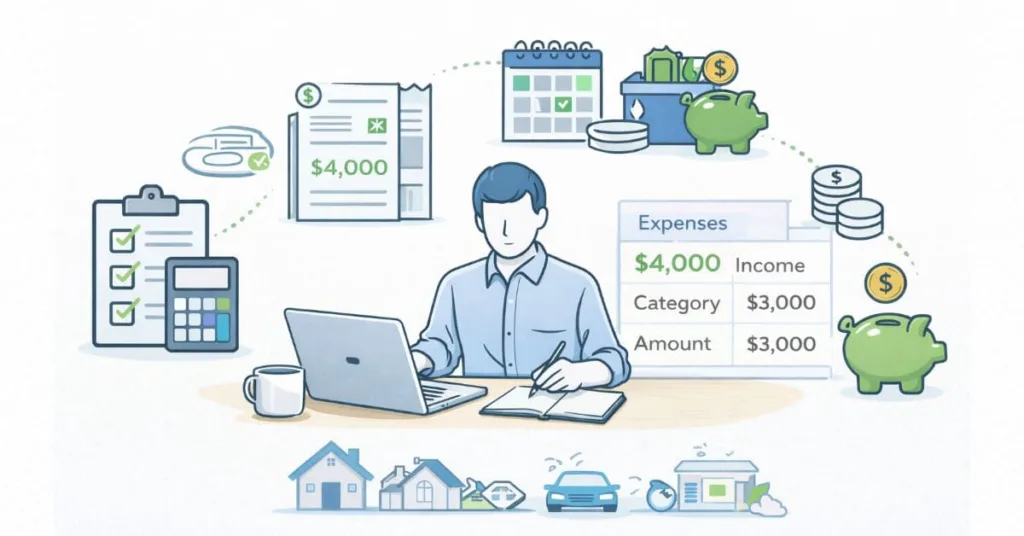
Getting started with money in the US can feel surprisingly confusing. There isn’t much structured financial education in school, and most people are expected to learn through trial and error once they enter adulthood. That’s why common money mistakes happen all the time — not because people are irresponsible, but because the system itself is complex, fast-moving, and filled with choices.
Many beginners also deal with cultural pressure around spending, comparison, and convenience. 📱 Online shopping, Subscriptions, and Tap-to-pay make it harder to keep track of where money goes. Add Credit cards, Bills, Rent, and rising day-to-day costs, and managing money starts to feel like a full-time skill that nobody really taught.
The good news is that most of these early mistakes are fixable once you can recognize them — and beginners often improve faster than they expect.
Why Many US Beginners Struggle With Money
Managing money in the United States feels harder than it seems on the surface. Most people reach adulthood without structured financial education, so topics like Budgeting, Credit, Bills, and Personal Finance Basics are learned through trial and error.
This creates a late learning curve, often during the same period when Rent, Bills, and Financial responsibilities begin showing up for the first time. Beginners aren’t just learning money concepts — they’re learning them under pressure.
The US financial environment is also decentralized. Banks, Credit Cards, Utilities, Loan servicers, and Subscription platforms all operate separately. There isn’t a single system that teaches how everything fits together.
For a beginner, it feels less like learning one subject and more like learning five different ones simultaneously — each with its own rules, terms, and potential penalties.
Consumer culture adds another layer. Spending has become extremely frictionless due to Promotions, Free Trials, Subscriptions, Buy Now Pay Later options, and Tap-to-pay technology. 🛍️ When purchases require less effort, budgets and awareness become harder to maintain, even for well-intentioned beginners.
Money also has an emotional and social dimension. Comparison, privacy norms, and shame make it difficult for beginners to ask questions or admit confusion. Instead of treating money as a skill that develops over time, many internalize financial struggles as personal shortcomings.
Even federal agencies acknowledge this learning gap. The Consumer Financial Protection Bureau (CFPB) publishes financial education resources to help US consumers build confidence and understanding. The existence of such programs highlights how difficult the system is for new learners to navigate alone.
How Our Brains Make Money Decisions (Beginner-Friendly)
Money decisions aren’t purely logical. Our brains are wired to favor comfort, convenience, and immediate certainty, which can clash with financial planning. Beginners often assume they “Lack Discipline,” but in reality, they’re running into hard-wired behaviors that almost everyone experiences.
These patterns become stronger in the United States because money choices are constant. Between Payments, Subscriptions, Digital Shopping, and Social Comparison, beginners navigate dozens of micro-decisions without realizing it. Over time, those decisions shape habits and spending patterns — often before any formal financial education begins.
Immediate Rewards vs. Future Costs
Humans naturally prioritize short-term rewards over long-term outcomes. Buying something now provides instant gratification, while saving or budgeting offers delayed benefits that are harder to feel in the moment. That gap makes spending easier and planning harder, especially for beginners who are just learning Personal finance basics.
Social Comparison Environment
Money also interacts with comparison. Social media, workplace culture, and peer groups introduce subtle pressure to match lifestyles — even when incomes and priorities vary. 📱 New phones, Dining out, Travel, and Subscription stacks become normalized through visibility, not necessarily affordability.
Decision Fatigue in Money Choices
Beginners in the US also face tremendous choice overload. Credit cards, Checking accounts, Phone plans, BNPL services, Insurance options, and subscription platforms all compete for attention. Choice abundance sounds empowering, but it creates decision fatigue. When the brain gets overwhelmed, it defaults to shortcuts, convenience, or avoidance — which often leads to unintentional spending or delayed financial learning.
Why Money Feels Harder Today for Beginners in the US
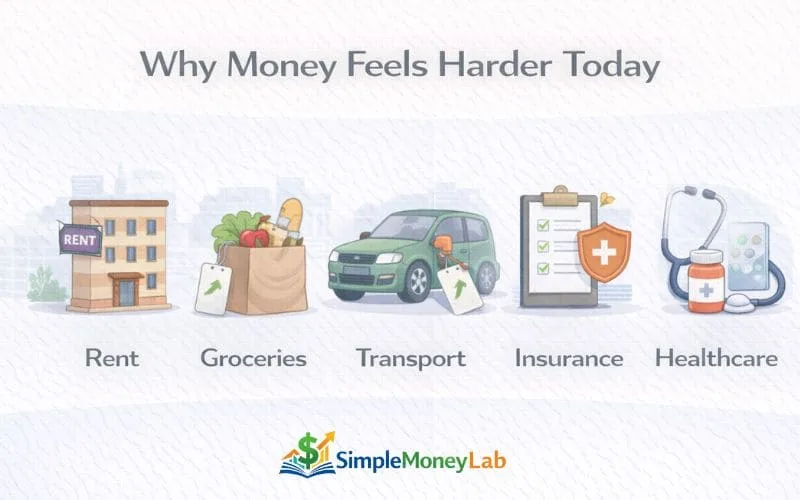
Money isn’t just hard because of financial literacy gaps — it’s also because the US environment itself has become more expensive and less predictable.
Young adults are entering adulthood during a period where costs rise faster than income clarity. That makes early financial learning feel heavier than it did for previous generations.
Cost Pressures Facing Young Adults
US living costs hit beginners in multiple categories at the same time. Rent, Groceries, Transportation, Insurance, Healthcare, and Utilities all require ongoing spending before anything else can be planned.
For many young workers, these essentials consume a large share of take-home income. When most of the paycheck goes toward fixed costs, it becomes harder to build buffers, experiment with habits, or plan for future goals.
Subscription services create additional baseline costs. Streaming platforms, phone plans, cloud storage, delivery memberships, and gaming subscriptions all stack quietly in the background.
Each service feels small on its own, but together they raise the minimum monthly cost of living for beginners — a dynamic that didn’t exist for earlier generations.
Inflation & Variable Pricing
Inflation has also made budgeting less predictable. Prices for groceries, Fuel, Rent, and Services shift month to month, making it harder for beginners to estimate stable spending categories.
When numbers don’t stay consistent, traditional budgeting can feel unreliable. Beginners often don’t know if the same category will cost more next month, which increases financial uncertainty.
Variable pricing extends beyond essentials. Airline tickets, Dining out, Entertainment, and Digital products often fluctuate based on demand, seasonality, and location.
This creates a financial environment where beginners must adapt to changing prices before they’ve even mastered foundational money skills.
9 Common Money Mistakes Beginners Make
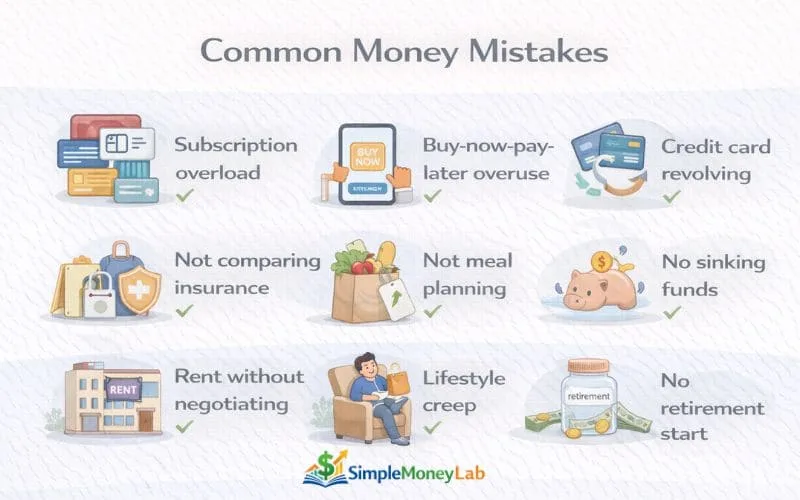
Money mistakes are common in the United States, especially for beginners who are learning how to navigate budgeting, bills, credit, and everyday financial decisions for the first time. Most mistakes are not caused by laziness or carelessness — they come from a lack of education and visibility. Here are nine beginner money mistakes that show up often during early financial adulthood.
Mistake #1 — Not Tracking Spending
One of the most common early money mistakes for US beginners is not knowing where money actually goes. Without visibility, money management becomes reactive instead of intentional. For many people, the challenge isn’t discipline — it’s awareness.
Digital payments intensify this pattern. Tap-to-pay, Online checkout, and Auto-renew subscriptions remove friction, Making purchases feel lighter in the moment. When spending feels effortless, tracking becomes harder.
This mistake is extremely common during the first working years because beginners are still learning how expenses flow across different categories such as rent, groceries, transportation, and recurring services.
How This Shows Up in Real Life
Beginners often recognize this mistake through patterns like:
- 💸 Paycheck “disappears” faster than expected
- 🏦 Account balance drops earlier in the month
- 🔁 Subscription renewals go unnoticed
- 🧾 Small purchases quietly accumulate
These signals are not red flags — they’re early indicators that spending is happening without visibility.
Beginner-Friendly Fixes
The first step isn’t strict budgeting — it’s visibility. Before choosing a budgeting style or tool, beginners benefit from simply observing where money naturally flows.
A 30–60 day spending snapshot is often enough to reveal categories, habits, and cost priorities. Many people are surprised to learn how much goes toward dining, transport, services, delivery, or “micro-convenience” purchases.
Once spending is visible, beginners can categorize it into buckets like:
- ✔ Recurring bills
- ✔ Essentials
- ✔ Transportation
- ✔ Food + Dining
- ✔ Services + Subscriptions
- ✔ Discretionary
Visibility becomes a bridge to planning. From here, many beginners naturally transition into Beginner Budgeting because tracking provides the context needed to build a simple structure without guessing.
Some budgeting mistakes don’t come from overspending but from misunderstanding how budgets behave in real life. Many first-time planners feel discouraged when their system doesn’t hold up under variable costs. That pattern is explained in Why budgeting feels hard for beginners, where structural and behavioral factors are broken down clearly.
📍 Goal: Visibility → Clarity → Intention (Not Perfection)
Mistake #2 — Relying on Mental Budgeting Instead of a Plan
Another common mistake beginners make is assuming they can keep spending organized in their head. At first, mental budgeting feels simple enough — Estimate Income, Remember Bills, and Spend the rest. The problem is that mental math breaks down quickly once real-life spending layers start stacking.
Digital payments and modern conveniences have reduced friction at checkout. Purchases no longer require Physical Cash, Visual Reminders, or Planning Pauses. When spending feels effortless, tracking becomes harder and memory becomes unreliable.
Why Mental Math Fails
Mental budgeting struggles because modern spending is fragmented across channels and timing. Beginners deal with:
- 💳 Card Swipes and Tap-to-pay
- 📱 Mobile Checkout and Delivery Apps
- 🔁 Auto-renew Subscriptions
- 🛍️ Promotions and Seasonal Sales
- 🚗 Variable Fuel and Transportation Costs
These categories hit at different times, in different amounts, through different platforms. Even highly organized people struggle to hold that information mentally without a system.
The result is predictable: beginners underestimate total monthly spending, especially in flexible categories like dining out, entertainment, convenience purchases, and digital services.
Simple Planning Alternatives
Beginners don’t need strict or complicated budgeting to replace mental math. Low-friction planning works better than rigid rules because it fits how people actually spend.
A simple spending plan can start with just three buckets:
- ✔ Essential Bills
- ✔ Variable Needs
- ✔ Discretionary wants
This format allows beginners to observe spending without feeling restricted. From there, some people choose to adopt the 50/30/20 Budgeting Method because it provides structure without micromanaging every dollar.
📍 Key Idea: Visibility and Structure outperform memory every time — especially in a Tap-to-pay, Subscription-based spending environment.
Mistake #3 — Treating Credit Like Free Money
Credit cards are often a beginner’s first interaction with borrowing. The challenge is that credit can feel like spending power rather than borrowed funds. When the credit limit shows a four-figure number, it’s easy to interpret it as available money, not as a short-term loan that must be repaid.
For beginners, this misunderstanding isn’t surprising. Credit is marketed as convenience and access — Tap, Swipe, or Store card information and the purchase goes through instantly. There’s no immediate pain signal the way there is when cash leaves the wallet.
Why It Happens
In the US, beginners typically receive access to credit before they receive education on how credit works. Physical and Digital checkout systems reinforce the illusion that credit equals money on hand. 🛍️
This creates a behavioral disconnect: Spending feels immediate, while repayment feels distant. When timing is separated, beginners default to short-term satisfaction and postpone thinking about Balances, Due dates, or Interest.
Marketing also plays a role. Card issuers promote Credit limits, Reward programs, and Convenience features, but repayment terms and utilization rules rarely get equal visibility. Without context, beginners assume they’re making normal choices — and in many cases, they are behaving exactly as the system incentivizes.
How Credit Actually Works in the US
Credit isn’t income — it’s borrowed money issued with the expectation of repayment. Every swipe creates a mini loan that must be paid back, and the cost of carrying that loan increases over time through interest.
Credit behavior also impacts future access. Repayment history, Utilization, and Account age contribute to How Credit scores work— a system that influences housing approvals, insurance pricing, deposits, and other everyday costs in the US.
The disconnect shows up here: beginners treat credit like spending power, while lenders treat it like a behavior signal. That gap creates many of the early mistakes that beginners later try to unwind.
Mistake #4 — Paying Bills Late
Late payments are one of the most common and expensive beginner money mistakes in the US. The issue isn’t usually intent — most beginners don’t purposely avoid bills. The problem is timing, structure, and overload.
When Paychecks, Rent, Utilities, Subscriptions, and Credit bills all operate on different schedules, beginners end up juggling dates rather than managing money. Once due dates start conflicting with cash flow, late fees and stress become predictable outcomes.
Real Causes
For many beginners, late payments come from logistical friction, not irresponsibility. Common real-world causes include:
- ⏳ Irregular Pay Cycles (bi-weekly pay vs monthly bills)
- 📅 Multiple Due Dates scattered across the month
- 🧾 Overlapping Bills that require batching decisions
- 📬 Digital + Paper billing mix that’s easy to miss
- 🔁 Autopay cancellations or Expired cards
These factors hit hardest during the first working years when beginners are still learning how cash flow interacts with billing systems.
Habit Adjustments
Beginners don’t need aggressive budgeting to fix late payments — small habit adjustments often work better. Examples include:
- Setting calendar reminders for due dates
- Aligning billing dates with payday when possible
- Using autopay for low-risk fixed bills
- Batching bill review once a month for visibility
These habits reduce cognitive load. When payments become predictable, the emotional and financial cost of late fees decreases sharply.
Mistake #5 — Not Building an Emergency Buffer
Many US beginners enter adulthood without an emergency buffer, not because they don’t care about saving, but because emergencies feel abstract until they happen. When all of a beginner’s income must cover rent, food, utilities, and transportation, the idea of setting money aside for an unknown future event becomes harder to prioritize.
There’s also a perception gap. Emergencies like Car repairs, Medical bills, Pet issues, or Sudden travel aren’t frequent enough to feel urgent — until they arrive. By then, beginners often rely on Credit, Borrowing, or Delayed payments to bridge the gap.
Why It’s Difficult for Beginners
Several forces make emergency buffers harder to build:
- 🧠 Behavioral Discounting: The brain favors current needs over future uncertainty
- 💰 Rising US Costs: Essentials consume a large share of take-home income
- 🚨 Surprise Expenses: Timing is unpredictable and stress-inducing
- ⏱️ Slow Income Growth: Early career wages often lag behind costs
These pressures stack, especially for young adults who are still learning financial habits while also absorbing economic realities.
Why Small Buffers Matter
Emergency buffers don’t need to be large to be useful. Even small cushions soften the impact of surprise expenses and reduce reliance on credit as the default backup.
They also reduce cognitive stress. When beginners have zero safety margin, every unexpected cost becomes a decision crisis. With even a modest buffer, surprise expenses shift from “financial emergencies” to manageable inconveniences.
Buffers also create time. Time to compare prices. Time to ask questions. Time to plan next steps instead of reacting immediately.
📍 Key Idea: Buffers protect both money and mental bandwidth.
Mistake #6 — Lifestyle Creep (Lifestyle Inflation)
Lifestyle creep is one of the most invisible money mistakes beginners encounter in the US. It happens when income increases and spending quietly scales up with it. Nothing extreme changes overnight — it’s the gradual upgrades that reshape financial reality over time.
For beginners, lifestyle creep often appears during career transitions. A raise, better job, or new role creates the feeling of “more room,” and that feeling encourages frictionless spending. Because the upgrades feel normal, it’s easy to miss how quickly the baseline cost of living increases.
US Cultural Examples
Lifestyle upgrades in the US are deeply cultural. They’re reinforced by convenience, social comparison, and seasonal spending. Common examples include:
- 📱 Phone Upgrades every 1–2 years
- 🎬 Streaming Stacks across multiple platforms
- 🍽️ Dining Out for convenience rather than occasion
- 🎁 Gifting Season expenses during holidays and events
- ✈️ Travel Expectations during holidays and long weekends
Each upgrade feels justified on its own, but collectively they shift what “normal” looks like.
Awareness-Based Adjustment
The goal isn’t to avoid upgrades — it’s to recognize when they become automatic. Lifestyle creep becomes costly when spending changes by default rather than intention.
Awareness creates a pause between impulse and habit. When beginners can identify lifestyle upgrades as choices rather than obligations, they gain more control over how income translates into well-being.
This shift doesn’t require strict budgeting or self-denial. It simply reframes spending as intentional rather than reactive.
Mistake #7 — Blending Wants With Needs
One reason beginners struggle with money in the US is because the boundary between wants and needs is no longer obvious. Modern spending is shaped by convenience, speed, and lifestyle expectations, which makes it harder to recognize what’s essential and what’s optional.
This blurring doesn’t happen intentionally. It happens because the market is designed to make “extras” feel normal, even when they weren’t always part of the baseline cost of living.
Subscription & Convenience Economy
The US consumer economy incentivizes convenience through services and memberships. Promotions, Delivery Platforms, Loyalty Programs, and Subscription models make discretionary spending feel routine. 📦
Streaming platforms, Food delivery, Cloud storage, Gaming passes, and Premium features all fall into categories that feel necessary for participation — even if they didn’t exist a decade ago. Over time, convenience-based spending merges into perceived “needs” without conscious decision-making.
Marketing reinforces this shift by messaging comfort, status, speed, and belonging. When everyone around you is paying for the same services, upgrades feel like the default rather than a choice.
Soft Categorization Model
Beginners don’t have to treat wants and needs as strict binaries. A softer categorization model works better because it reflects how people actually live.
A helpful starting point is:
- ✔ Needs: Foundational costs required to function (Housing, Food, Transportation, Healthcare, Connectivity)
- ✔ Wants: Enhancements that improve Comfort, Convenience, or Enjoyment
This framing doesn’t judge spending — it simply creates clarity. Once beginners can distinguish between the two, it becomes easier to prioritize, adjust, or pause certain categories during tight months.
This is where Categorizing Needs vs Wants naturally appears inside beginner budgeting because a plan reveals how spending maps across lived priorities.
Mistake #8 — Underestimating Credit Score Impact
Credit scores often feel like a distant concept to beginners — something that matters “later” or only for loans. In reality, credit touches everyday life in the United States much sooner than most people expect. Even people who don’t use credit cards or avoid borrowing discover that credit plays a role in access, pricing, and approval decisions.
The disconnect happens because credit is largely invisible until it becomes relevant. Beginners don’t see the credit system operating in the background, so its importance is easy to underestimate.
Everyday Areas Credit Influences in the US
Credit scores affect more than just lending. In the US, they can influence basic life situations such as:
- 🏠 Housing Approvals (Rentals and Leases)
- 🚗 Auto Insurance Pricing in many states
- 🔌 Utility Deposits for Electric, Gas, and Internet
- 📱 Cell Phone Plans and Device financing
- 💼 Employment Checks for certain regulated roles
These aren’t luxury decisions — they’re everyday access points. When credit is weak or nonexistent, beginners may face deposits, additional paperwork, or higher friction during these transitions.
In a country where independence often starts with renting, relocating, or accessing transportation, the credit system shows up much earlier than expected.
Long-Term Access Cost
Ignoring credit doesn’t make it go away — it simply creates more friction later. Beginners who postpone credit entirely often discover that starting Building Credit from Zero takes time.
Credit scores reward consistency and history, not instant activity. Because history grows slowly, the delay cost becomes real. Someone who begins at 18 builds maturity faster than someone who waits until 28, even if both behave responsibly.
When credit is treated as an afterthought, beginners may run into avoidable barriers during life transitions such as moving apartments, buying a car, or activating utilities. The cost isn’t always financial — sometimes it’s time, stress, or reduced flexibility.
Many beginners don’t realize How Credit scores affect your financial life until they encounter deposits, premiums, or rental screenings.
📍 Key Idea: Credit isn’t about borrowing money — It’s about enabling access.
Mistake #9 — Doing Everything Alone
Many beginners in the US try to figure out money privately. They assume they should “Already Know” how to budget, handle credit, or make financial decisions, even though nobody formally teaches these skills. This isolation delays learning and increases stress because mistakes pile up before anyone seeks clarity.
Money is one of the few life skills people feel pressured to master without conversation. Beginners often talk openly about jobs, lifestyle, or relationships, but go silent when finances come up — even among close friends or family.
Money Shame & Privacy Culture in the US
In the United States, Money carries both emotional and cultural weight. Privacy norms make it normal to talk about earnings, spending, or debt only in vague terms, if at all. 🗃️
Beginners hesitate to ask questions because they don’t want to appear irresponsible, uninformed, or behind. This leads to what researchers call “Money Shame” — the discomfort or embarrassment that prevents people from seeking help.
The irony is that most adults are quietly figuring things out too. The people beginners assume “know what they’re doing” are often learning alongside them.
Beginner-Friendly Learning Sources
The good news is that beginners don’t need mentors, expensive coaches, or financial advisors to learn the basics. There are public and non-commercial resources designed specifically for financial literacy.
Examples include:
- 🏛️ Government Consumer Education (CFPB, FTC, FDIC)
- 📚 Public Libraries with financial workshops and literacy programs
- 🏫 Community Colleges offering low-cost personal finance courses
- 🌐 Non-profit Financial Education Programs focused on adults and young workers
These options remove pressure, reduce shame, and create a supportive environment for learning. They also ensure information is unbiased, non-commercial, and designed for long-term understanding rather than quick fixes.
📍 Key Idea: Money is a skill — and skills are learned faster together, not alone.
How Beginners Can Improve Gradually
Improving Personal finance doesn’t require dramatic lifestyle changes or strict budgeting systems. Beginners often benefit more from slow, repeatable habits than from intense financial overhauls. Small shifts create the foundation for long-term clarity because they blend into daily life instead of fighting against it.
Many people assume financial improvement requires big leaps — aggressive saving, cutting expenses, switching careers, or chasing more income. In reality, early progress usually comes from awareness, not drastic restructuring.
Beginners can start by observing spending instead of judging it. Visibility allows patterns to surface, and patterns reveal where money naturally flows. Once those patterns are clear, prioritization becomes simpler because decisions are based on reality rather than assumptions.
Tiny habit changes matter here. Examples include scanning monthly statements, checking subscription renewals, aligning due dates with paydays, or using reminders for bills. None of these actions demand deprivation or sacrifice, yet they reduce stress and create structure.
Gradual improvement also protects mental bandwidth. When beginners avoid extreme strategies, they have the capacity to learn credit, understand costs, and ask better questions over time. This approach builds confidence instead of panic — a key difference for long-term financial stability.
Financial progress isn’t about intensity — It’s about consistency that fits real life.
FAQs About Common Money Mistakes
Are Money Mistakes Common for beginners?
Yes. Money mistakes are extremely common for beginners in the United States, especially because most people don’t receive structured financial education in school or at home. Many adults enter the workforce without knowing how to budget, manage bills, or understand credit. As a result, the first few years of financial independence often involve trial and error. These mistakes are not a sign of failure — they’re a reflection of a system where people are expected to learn personal finance on the job rather than through guidance or training.
What’s the biggest beginner money mistake?
One of the most widespread beginner mistakes is not tracking spending. When people don’t know where their money is going, budgeting, planning, and saving become extremely difficult. This leads to situations where paychecks disappear quickly, balances drop earlier in the month than expected, or subscriptions renew without being noticed. Once spending is tracked, beginners often feel more in control because they can see patterns instead of guessing. Visibility usually becomes the starting point for all other financial improvements.
Do Budgets have to be strict to work?
No. Budgets don’t need to be strict or restrictive to be effective. Many US beginners benefit from simple spending plans that help them understand their cost priorities without forcing them to cut everything they enjoy. The purpose of a beginner-friendly budget is clarity, not deprivation. When budgets are framed as tools for awareness instead of punishment, people are more likely to stick with them and make adjustments over time. Flexible systems tend to work better than rigid ones, especially in the early stages.
Do Credit scores matter if I’m not borrowing money?
Yes. In the United States, credit scores influence many areas of everyday life beyond borrowing. Landlords may check credit for rental applications, utility companies may require deposits based on credit, and some auto and renters insurance companies factor credit into pricing. Certain cell phone plans and device financing options also use credit data. Because of this, ignoring credit doesn’t remove it from your life — it simply delays interaction with the system until a point where access, pricing, or flexibility may be affected.
How long does it take to improve Personal Finance habits?
It varies. Personal finance habits build gradually because they involve behavior, awareness, and consistency over time. Many beginners start seeing improvement within a few months once they track spending, organize bills, and understand how credit works. However, long-term habits such as building savings buffers, improving credit profiles, or reducing reliance on reactive spending typically take longer. The important part is that improvement is not linear — it develops through small adjustments that accumulate rather than dramatic overhauls.
Can beginners learn Personal finance without professional help?
Yes. Many people learn personal finance through self-education, public resources, and gradual experience rather than through professional advisors. Public libraries, government agencies, non-profit education programs, and community colleges offer beginner-friendly material that is unbiased and non-commercial. Personal finance is a skill that becomes easier with familiarity, and most beginners improve simply by gaining visibility into their spending, learning basic credit mechanics, and becoming more intentional about financial decisions over time.
Final Thoughts
Learning how to manage money takes time, and beginners in the United States often enter adulthood without a roadmap. Early mistakes don’t reflect irresponsibility — they reflect a system where financial skills are expected without being taught. Normalizing that gap removes shame and helps beginners focus on improvement instead of self-criticism.
Money also becomes easier once it feels less private. When people talk about spending, credit, bills, and habits without embarrassment, they discover that almost everyone experiences similar challenges. Shared understanding reduces isolation and speeds up learning because questions become easier to ask.
Once beginners build awareness around spending, credit, and bills, the next stage of personal finance often involves increasing financial flexibility through earning. Many people explore Side hustles for beginners once they’ve built basic stability because supplemental income becomes easier to manage with context rather than desperation.
Financial progress is a journey of Clarity, Not Perfection. The skills compound over time, and beginners improve faster than they initially expect.

I’m Daniel Moore, the founder of SimpleMoneyLab, where I help beginners learn Personal Finance in a simple and realistic way. I focus on breaking down Budgeting, Credit Basics, and Side Hustles into plain English so everyday Americans can feel more confident with Money.