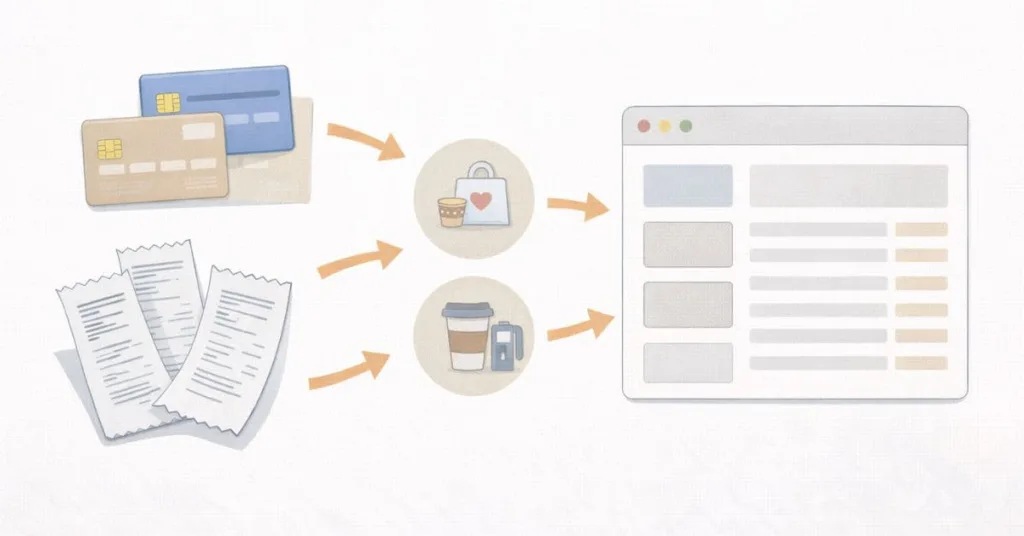
Many beginners feel overwhelmed when they hear that they should track every dollar they spend. It often sounds time-consuming, restrictive, and mentally exhausting. This reaction is common — especially for people navigating money decisions for the first time in the United States, where payments happen across cards, apps, auto-renewals, and digital wallets.
Learning how to track spending without overwhelm starts with correcting a common misunderstanding. Spending tracking is not about restriction — it’s about visibility. It shows where money goes, not where it’s allowed to go. That difference reduces pressure and increases clarity.
The modern US payment environment adds complexity. Small transactions stack up quickly, subscriptions renew quietly, and mixed billing cycles blur totals. With the right framing, tracking becomes observation — not control.
Why Spending Tracking Feels Overwhelming for Beginners
For many beginners, spending tracking feels overwhelming not because it’s complex by design, but because modern money movement is constant and fragmented. Transactions happen in small amounts across multiple platforms, which makes spending harder to see as a complete picture. When visibility is low, tracking feels heavier than it should.
The challenge isn’t effort alone — it’s volume and fragmentation.
Several modern patterns increase tracking stress:
- Too many small daily transactions across cards and apps
- Digital payments reduce the “Pain Signal” of spending
- Subscription renewals happen quietly in the background
- Multiple billing cycles blur monthly totals
All of this adds cognitive load. Instead of seeing a few clear expenses, beginners see dozens of scattered charges. That mental processing cost — more than the math — is what creates overwhelm.
Spending patterns are easier to interpret when income stages are clearly understood. Knowing what is disposable income helps explain how much money is actually flowing into daily spending behavior over time. And, understanding what is an emergency fund helps explain how financial protection can gradually develop as spending patterns become clearer.
Tracking feels hard when money is fragmented, not when people are incapable.
What Spending Tracking Actually Means
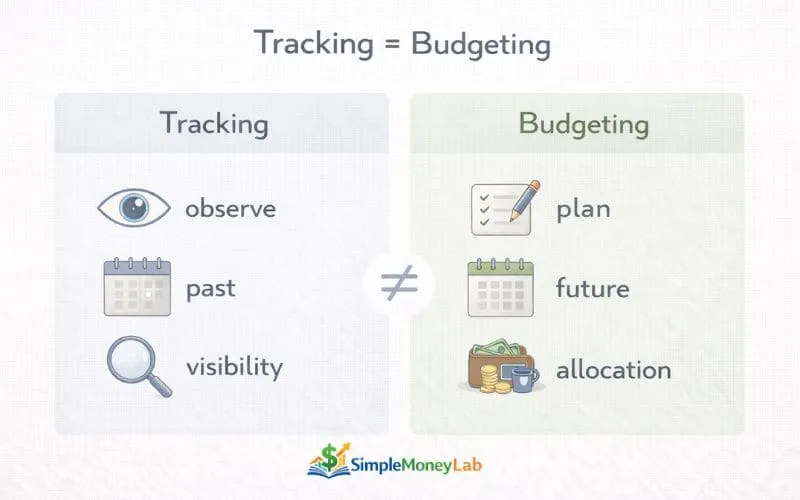
Many beginners misunderstand spending tracking because it’s often presented alongside strict budgeting systems. As a result, tracking feels like enforcement instead of awareness. In practice, spending tracking has a much simpler purpose — it helps make money movement visible.
Tracking is descriptive, not controlling.
Here’s the beginner-friendly framing:
- Tracking ≠ Budgeting — Budgeting plans future spending, tracking observes past spending
- Tracking = Visibility — It shows where money actually goes
- Tracking ≠ Restriction — It does not automatically limit choices
- Tracking = Observation — It focuses on patterns, not punishment
This distinction reduces pressure. When tracking is treated as observation, beginners feel less resistance and more curiosity about their spending behavior.
That connection between budgeting pressure and tracking overwhelm is also explained in Why budgeting feels hard for beginners, where expectation gaps and behavioral load are discussed in detail.
Spending tracking is a visibility tool, not a control system.
Common Tracking Mistakes That Cause Burnout
Spending tracking usually doesn’t fail because the method is wrong — it fails because the approach becomes too heavy to maintain. Beginners often start with high effort and high expectations, which quickly turns tracking into a stressful task instead of a helpful one.
Burnout comes from friction, not from lack of discipline.
Tracking Too Many Categories 🧩
Some beginners create very detailed category systems at the start.
- Too many labels
- Too many sub-groups
- Too many split transactions
This level of detail increases mental load and slows down every entry, making tracking feel like paperwork.
Tracking Daily Perfection 📅
Trying to record every transaction perfectly, every day, creates pressure.
- Missed entries feel like failure
- Delays create backlog stress
- Catching up feels exhausting
Perfection-based tracking rarely lasts long for beginners.
Tool Overload 🛠️
Using multiple tracking tools at once often increases confusion.
- App + Spreadsheet + Notes
- Duplicate Entries
- Mismatched Totals
Instead of clarity, beginners get conflicting numbers and more mental friction.
Shame-Driven Tracking 😔
Tracking motivated by guilt or self-criticism becomes emotionally heavy.
- Numbers feel Judgmental
- Reviews feel Uncomfortable
- Avoidance increases Over time
This pattern appears frequently among Beginner Money Mistakes, where emotional pressure reduces consistency instead of improving it.
Tracking breaks when emotional pressure and system complexity rise together.
Simple Low-Friction Ways to Track Spending
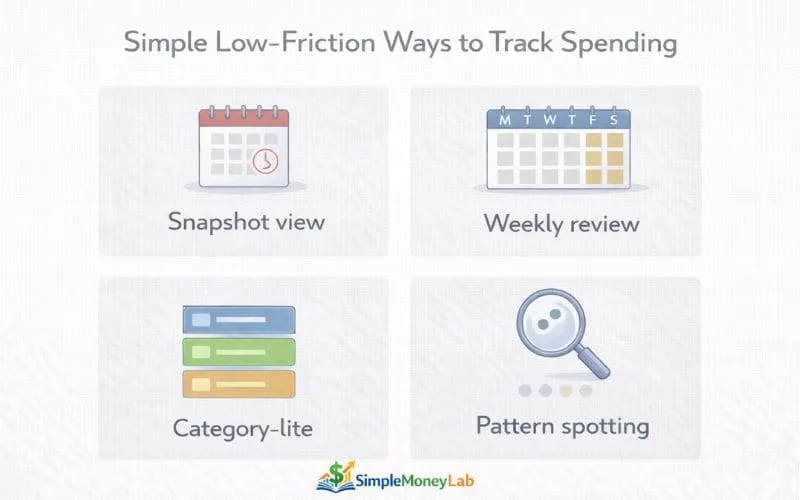
Spending tracking feels more sustainable when the method matches a beginner’s mental bandwidth. Lower friction approaches reduce resistance and make visibility easier to maintain. The goal isn’t maximum detail — it’s consistent awareness.
These lighter approaches focus on patterns instead of precision.
Snapshot Tracking 📸
Snapshot tracking looks at spending in short summaries instead of constant logging.
- Periodic check-ins instead of continuous recording
- Summary views instead of line-by-line focus
- Trend awareness over transaction detail
This reduces cognitive load while still improving visibility.
Category-Lite Tracking 🗂️
Some beginners find it easier to work with fewer categories.
- Broad groups instead of many sub-categories
- Essential vs Flexible spending views
- Simplified labels that match real habits
Fewer categories mean faster sorting and less decision fatigue.
Weekly View vs Daily View 📆
Daily tracking can feel intense for beginners.
A weekly view often feels lighter because:
- Patterns are easier to notice
- Small misses matter less
- Review time feels contained
Zooming out slightly reduces pressure without removing awareness.
Pattern Spotting 🔎
Pattern spotting focuses on behavior signals instead of perfect totals.
- Repeat purchase types
- Timing patterns
- Convenience spending clusters
- Subscription stacking
This approach treats tracking as observation, not scoring.
Low-friction tracking improves consistency by lowering mental effort, not by lowering awareness.
Manual vs Digital Tracking — What Changes
Spending can be tracked manually or digitally, and each method creates a different experience for beginners. The difference is not just about format — it affects how information is seen, processed, and felt. Understanding these differences helps reduce confusion when choosing a tracking style.
This is not about which method is better. It’s about how each one feels in practice.
Manual Tracking Feel ✍️
Manual tracking usually involves writing entries in a notebook or simple sheet.
- Slower but more intentional
- Higher awareness per entry
- Fewer but more deliberate reviews
Because each transaction is recorded by hand, awareness tends to feel more direct.
Digital Tracking Feel 💳
Digital tracking collects and organizes transactions automatically or semi-automatically.
- Faster Capture
- Higher Transaction Volume
- Easier Summaries
This increases coverage but can reduce the “Pause Moment” between spending and recording.
Visibility Difference 👀
Both methods create visibility, but in different ways.
- Manual methods create close-up visibility
- Digital methods create wide-angle visibility
- Manual = Depth per entry
- Digital = Breadth across entries
Beginners often respond differently depending on which type of visibility feels less stressful.
Emotional Friction Difference 🧠
Tracking methods also differ in emotional friction.
- Manual tracking can feel heavier but more grounding
- Digital tracking can feel lighter but more distant
- Manual review feels slower
- Digital review feels faster but more abstract
Clarity improves when expense categories are already understood. That’s why knowing Fixed vs Variable expenses supports smoother tracking regardless of method.
Tracking method changes the experience — Not the purpose — of spending visibility.
Spending Visibility vs Spending Control
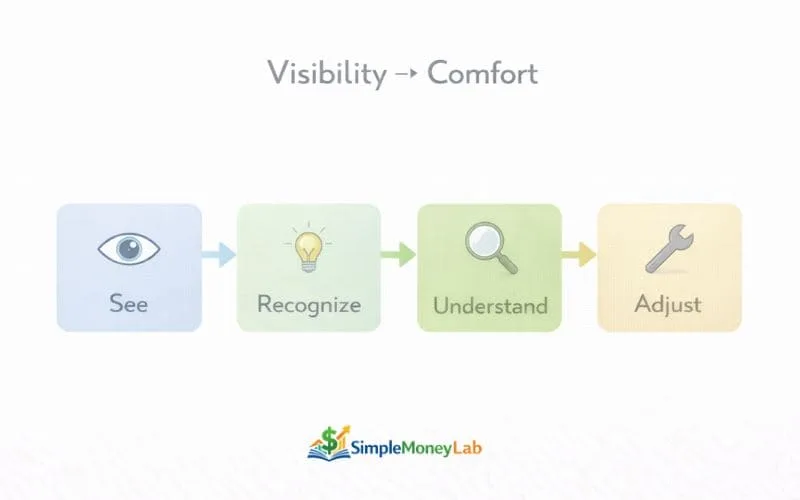
Many beginners start tracking spending because they want more control. But in practice, control is not the first outcome — visibility is. This difference matters, because expecting control too early often leads to frustration and dropout.
Tracking shows behavior before it changes behavior.
Understanding this sequence reduces pressure and makes the process feel more realistic.
Visibility First 👀
The first effect of tracking is visibility.
- Where money goes
- When spending happens
- Which categories repeat
- How small purchases stack
At this stage, nothing is being fixed — only seen. Visibility builds the foundation for later decisions.
Control Later 🎛️
Control develops after patterns become familiar.
- Adjustments follow awareness
- Timing becomes clearer
- Trade-offs feel more informed
When beginners expect immediate control, tracking feels like it’s not working — even though it’s doing its first job correctly.
Awareness Discomfort Phase 😬
Early visibility often feels uncomfortable.
- Totals look higher than expected
- Habits become more visible
- Convenience spending stands out
This discomfort is common and temporary. It reflects new awareness, not failure.
Pattern Recognition Stage 🔍
After repeated observation, patterns begin to stand out.
- Repeat Merchants
- Timing Clusters
- Category Spikes
- Seasonal Changes
At this stage, spending feels more predictable and less mysterious.
Visibility creates understanding first — Control grows from understanding later.
US-Specific Factors That Make Tracking Harder
Spending tracking feels heavier in the United States because money moves through multiple systems at once. Payments are spread across cards, bank transfers, auto-charges, and service platforms. When transactions are distributed across channels and timelines, visibility drops and mental effort increases.
The difficulty often comes from structure — not from lack of effort.
Multi-Payment Methods 💳
Most US consumers use more than one payment method.
- Debit and Credit cards
- Bank transfers
- Digital wallets
- Buy-now-pay-later splits
When spending is divided across sources, totals are harder to see in one place.
Auto Renewals 🔁
Many services renew automatically.
- Streaming and Software subscriptions
- Memberships
- Cloud and Storage plans
- Recurring Service fees
Because these charges don’t require active checkout each time, they’re easier to overlook during tracking.
Healthcare Bills 🏥
Healthcare billing adds irregular and delayed charges.
- Claims processed weeks later
- Multiple statements for one visit
- Insurance adjustments
- Separate provider billing
This delay between service and charge makes spending timelines harder to follow.
Mixed Billing Cycles 📅
Not all US bills follow the same monthly cycle.
- Rent may be monthly
- Insurance may be semi-annual
- Subscriptions renew on signup dates
- Utilities bill by usage periods
When billing cycles don’t align, monthly tracking feels less clean and more fragmented.
US payment structure increases fragmentation, which increases tracking friction.
How Beginners Can Track Spending Without Overhauling
Spending tracking doesn’t need a complete system reset to be useful. For most beginners, progress comes from lighter, repeatable awareness — not from perfect records or detailed systems. When tracking is framed as observation instead of enforcement, it feels easier to continue.
A behavior-first approach reduces pressure and improves consistency over time.
Behavior Framing That Reduces Overwhelm 🧠
Instead of focusing on perfect tracking, beginners often respond better to simple awareness principles:
- Awareness > Perfection — Seeing patterns matters more than exact totals
- Consistency > Detail — Repeat check-ins matter more than deep categorization
- Observation > Judgment — Noticing spending works better than criticizing it
- Pattern > Precision — Trends are more useful than perfect line items
This mindset turns tracking into a learning activity rather than a scoring system.
Spending visibility naturally supports planning later. That connection is explained in Monthly budgeting basics, where spending awareness feeds directly into more realistic budgets.
Tracking works best when it stays light enough to repeat.
FAQs About How to Track Spending Without Overwhelm
What is the easiest way to track spending?
The easiest way to track spending is the method that feels light enough to repeat consistently. For many beginners, simple summary tracking — such as reviewing totals by category or by week — feels easier than recording every transaction in detail. Ease comes from low mental friction, not from advanced tools or complex systems.
Do I need apps to track spending?
No. Spending can be tracked manually or digitally. Some people prefer writing entries because it increases awareness, while others prefer automated summaries because they reduce effort. Both approaches can create visibility. The difference is in experience and comfort, not correctness.
How often should I track spending?
Tracking frequency varies by preference and tolerance. Some beginners feel more comfortable reviewing spending weekly instead of daily because it reduces pressure and backlog stress. What matters most is repeatability — tracking that happens regularly tends to produce clearer patterns over time.
Is spending tracking the same as budgeting?
No. Spending tracking and budgeting serve different purposes. Tracking observes where money has already gone, while budgeting plans where money is expected to go. Tracking builds visibility first, and budgeting uses that visibility later for planning.
Why does tracking feel stressful at first?
Tracking can feel stressful early on because it increases visibility. Totals may appear higher than expected, and spending habits become more noticeable. This discomfort is a common awareness phase, not a sign that tracking is being done incorrectly.
How long until tracking feels easy?
Tracking usually feels easier after patterns become familiar. As spending categories and timing repeat, reviews take less effort and fewer surprises appear. Comfort grows with familiarity, not perfection, and timelines differ from person to person.
Final Thoughts
Feeling resistance toward spending tracking is normal, especially in the beginning. For many US beginners, the discomfort doesn’t come from the act of tracking — it comes from seeing money patterns clearly for the first time. That early friction is part of the awareness phase, not a sign of failure.
Spending visibility builds clarity gradually. As transactions become familiar and patterns repeat, reviews feel lighter and less emotional. Tracking works as a skill that improves with exposure, not as a personality trait someone either has or doesn’t have.
After basic tracking feels manageable, the next layer is understanding different Spending Tracking Systems and how they support ongoing visibility without adding pressure.
Visibility first, comfort later — and both grow with practice, not perfection.

I’m Daniel Moore, the founder of SimpleMoneyLab, where I help beginners learn Personal Finance in a simple and realistic way. I focus on breaking down Budgeting, Credit Basics, and Side Hustles into plain English so everyday Americans can feel more confident with Money.