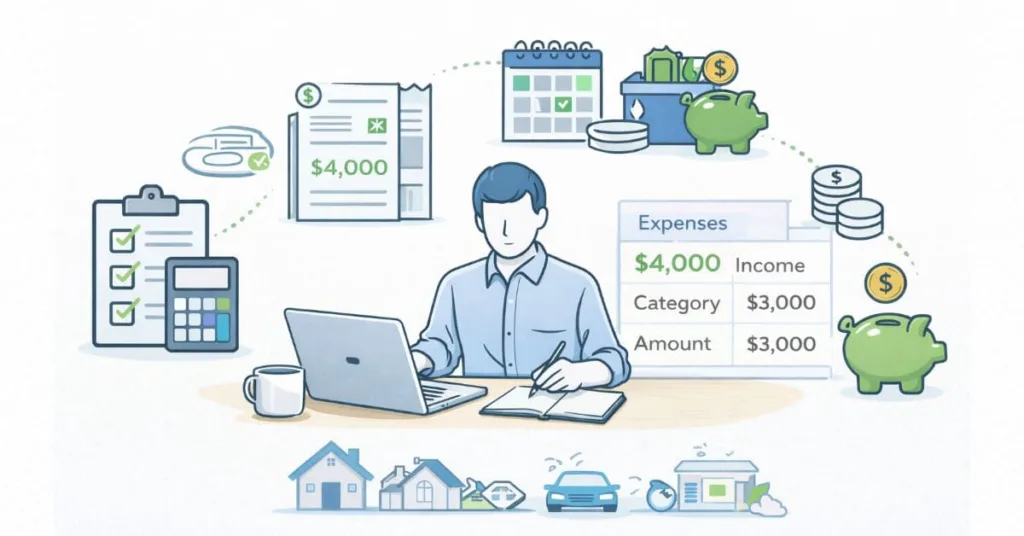
Many beginners feel confused when trying to categorize expenses, especially when budgeting for the first time. Fixed and variable expenses sound simple in theory, but real-life spending in the United States doesn’t always fit neatly into those boxes. This confusion is normal, not a sign of doing something wrong.
Budgeting often breaks down when expenses are mislabeled. Beginners may treat flexible costs as fixed or assume predictable bills can’t change. Over time, this mismatch creates frustration because the budget stops reflecting how money actually moves. Rent increases, utility bills fluctuate, grocery costs rise, and subscriptions quietly add up.
Understanding the difference between fixed and variable expenses helps bring clarity back into budgeting. It allows beginners to see which costs are stable, which ones change, and why some categories need more flexibility than others. That clarity is often the missing piece that makes budgeting feel more realistic and manageable.
Why Expense Type Confusion Breaks Budgets
Many beginners assume expenses behave the same way each month. If a bill exists, it’s expected to stay stable. In reality, expenses move differently based on how they’re structured, billed, and influenced by daily life. When budgets treat all expenses as equal, small misalignments turn into recurring problems.
Some costs are predictable but inflexible, while others change based on usage, timing, or lifestyle choices. Without recognizing these differences, beginners end up building budgets that feel accurate on paper but fail in practice.
In the United States, billing systems add another layer of confusion:
- Subscriptions renew automatically
- Utilities fluctuate with usage and seasons
- Insurance and rent change over time
- Services bundle fixed and usage-based fees
When expense types aren’t clearly understood, budgets stop reflecting reality — and frustration grows even when spending hasn’t dramatically changed.
Budgets fail faster when expenses are mislabeled, not when spending is careless.
For readers who want a neutral government overview of how expense categories fit into budgeting, the CFPB budgeting resource page explains how recurring and variable costs are typically grouped.
What Are Fixed Expenses?
Fixed expenses are costs that stay predictable and recurring over time. These expenses usually appear on a regular schedule and don’t change much from month to month. Because of this consistency, fixed expenses are often the easiest for beginners to identify.
That said, “fixed” does not mean permanent. It simply means the amount is relatively stable for a period of time.
Common Fixed Expense Examples (US)
In the United States, fixed expenses commonly include:
- Rent or Mortgage payments
- Insurance Premiums (Auto, Renters, Health)
- Subscriptions and Memberships
- Loan or Installment payments
These expenses usually have set due dates and expected amounts, which makes them feel more manageable when budgeting.
Why Fixed Expenses Feel “Safe”
Fixed expenses often feel safe because they’re predictable.
However:
- Predictable does not mean flexible
- Fixed costs are harder to reduce quickly
- They still take up a large share of cash flow
Because fixed expenses form the foundation of most budgets, understanding how they work is essential. This is why Monthly budgeting basics often start by identifying fixed costs before anything else.
Fixed expenses create structure, but too many fixed costs can make a budget fragile.
What Are Variable Expenses?
Variable expenses are costs that change from month to month. The amount isn’t fixed and often depends on usage, habits, or timing. Because these expenses don’t follow a set pattern, they’re harder for beginners to predict when building a budget.
Common Variable Expense Examples (US)
In the United States, variable expenses often include:
- Groceries
- Gas and transportation fuel
- Dining out and takeout
- Utilities such as electricity and water
- Entertainment and leisure spending
These expenses can look similar each month, but small changes add up quickly.
Why Variable Expenses Cause Budget Stress
Variable expenses create stress because they’re less predictable.
They tend to be:
- Influenced by daily decisions
- Affected by convenience and emotions
- Sensitive to inflation and seasonal changes
When variable costs rise unexpectedly, budgets feel like they “fail,” even though the spending itself may be normal. This is why variable expenses often drive frustration for beginners.
Variable expenses introduce flexibility, but they also introduce uncertainty.
Fixed vs Variable Expenses — Side-by-Side Comparison
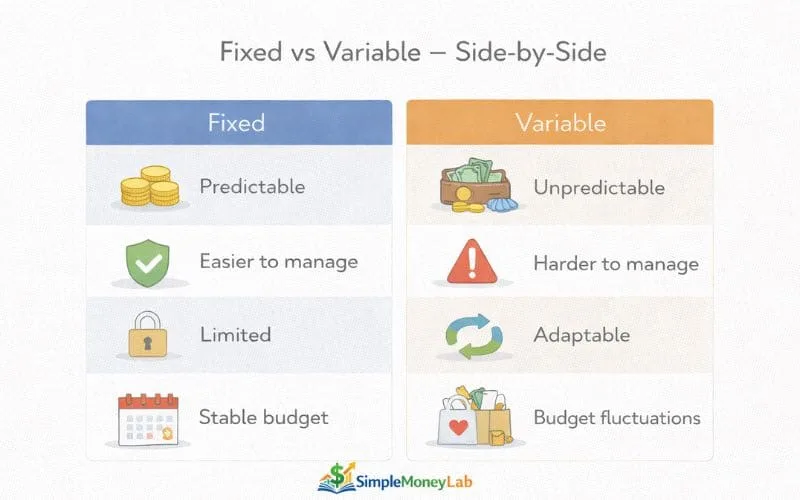
Fixed vs Variable expenses side by side helps beginners understand why some budgets feel stable while others feel unpredictable. This comparison shows how each expense type behaves in real life.
Fixed vs Variable Expenses (Comparison Table)
| Feature | Fixed Expenses | Variable Expenses |
|---|---|---|
| Predictability | Mostly stay the same each month | Change from month to month |
| Payment Amount | Set or pre-determined | Depends on usage and habits |
| Short-Term Control | Limited flexibility | More adjustable over time |
| Impact on Budget | Forms the base of the budget | Determines monthly balance |
| Reaction to Inflation | Changes slowly over time | Responds quickly to price changes |
| Emotional Influence | Low (automatic or scheduled) | High (choices, convenience, stress) |
| Ease for Beginners | Easier to identify | Harder to predict |
| Adjustment Speed | Slow to change | Can shift gradually |
When beginners treat all expenses the same, budgets lose accuracy. Fixed expenses create structure, while variable expenses introduce movement. Understanding this difference helps budgets reflect how money actually behaves — not how it’s expected to behave.
Budgeting becomes easier when expense behavior is understood, not controlled.
Expenses That Confuse Most Beginners
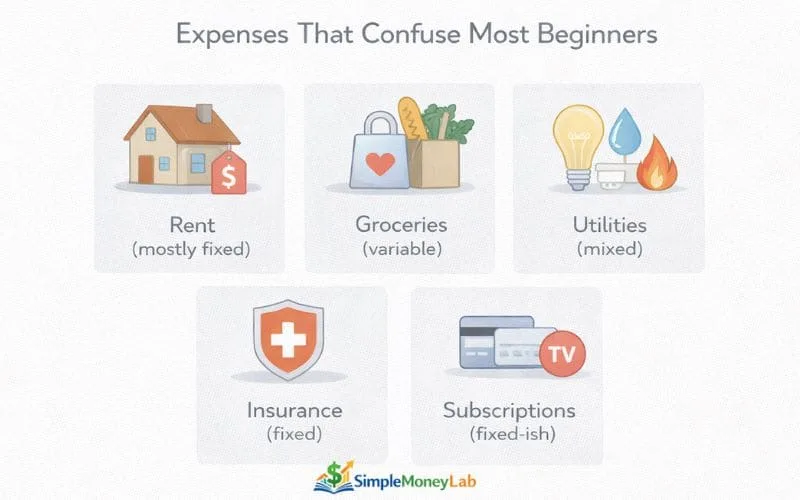
Some expenses don’t fit neatly into “fixed” or “variable” categories. This gray area is where many beginner budgets lose accuracy. When these expenses are mislabeled, expectations break — and frustration follows.
Is Rent Fixed or Variable? 🏠
Rent is mostly fixed, but not permanently fixed.
- The monthly payment is predictable during a lease
- Increases often happen yearly
- Renewals, relocations, and fees change the amount
Because rent feels stable month to month, beginners may forget it can still change over time.
Are Groceries Fixed or Variable? 🛒
Groceries are essential, but the cost is flexible.
- Food is required every month
- Spending varies by choices, prices, and timing
- Inflation and convenience affect totals
This makes groceries variable in behavior, even though they feel unavoidable.
Utilities — Fixed, Variable, or Both? ⚡
Utilities often combine two behaviors.
- A base service charge stays consistent
- Usage-based charges fluctuate monthly
Electricity, Water, Gas, and Internet bills usually include both fixed and variable components, which makes them harder to predict without past visibility.
Confusion around these mixed expenses is a common reason budgets feel unreliable. This pattern directly connects to Why budgets fail for beginners — not because spending is careless, but because expense behavior isn’t clearly understood.
Budgets improve when confusing expenses are recognized as mixed, not forced into one category.
How Expense Types Affect Budgeting Outcomes
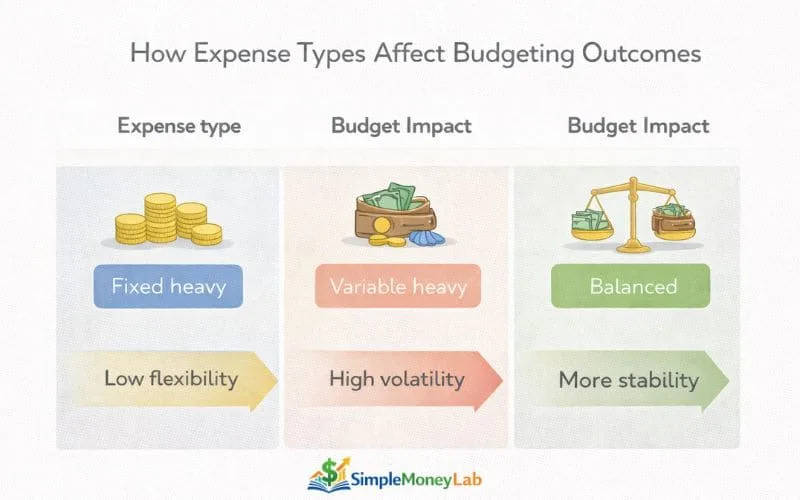
Expense types don’t just describe spending — they shape how a budget behaves over time. When fixed and variable expenses aren’t balanced, budgeting feels unstable even when income hasn’t changed. Understanding this relationship helps explain why some budgets feel fragile while others feel more resilient.
Fixed Expenses Limit Flexibility 🧱
Fixed expenses reduce how much room a budget has to adjust.
- A high share of fixed costs leaves little breathing room
- Unexpected expenses become harder to absorb
- Small changes create larger disruptions
When most income is locked into fixed payments, even normal variability can feel overwhelming.
Variable Expenses Create Overruns 🔄
Variable expenses are where budgets often drift.
- Emotions influence daily spending
- Convenience decisions add up quietly
- Inflation and timing increase unpredictability
These overruns don’t come from poor intentions — they come from how variable costs respond to daily life.
Balanced Mix = Sustainable Budget ⚖️
Budgets tend to feel more stable when neither expense type dominates.
- Fixed expenses provide structure
- Variable expenses allow flexibility
- Balance reduces stress and volatility
When expense types are understood together, budgets feel more realistic and easier to maintain.
Budgeting outcomes improve when expense behavior is recognized, not resisted.
How Beginners Can Use Expense Types Without Overhauling
Understanding fixed and variable expenses doesn’t require a full system reset. For most beginners, the benefit comes from awareness, not strict control. When expense types are recognized clearly, budgeting feels more descriptive and less restrictive.
This approach focuses on interpretation, not perfection.
Behavior-First Framing 🧠
A lighter, behavior-first view makes expense categories easier to work with:
- Awareness > Control — Seeing patterns matters more than forcing limits
- Labeling > Restriction — Naming expense behavior improves clarity
- Adjustment > Perfection — Small shifts matter more than exact accuracy
Expense types are meant to explain spending behavior, not judge it.
When beginners start recognizing which costs are stable and which tend to move, financial decisions feel less surprising. That visibility often reduces stress and improves confidence without adding pressure.
Building that visibility is easier through tracking spending without feeling overwhelmed, where spending patterns become clearer over time without rigid systems.
Expense categories are a lens for understanding — not a rulebook for spending.
FAQs About Fixed vs Variable Expenses
What is the difference between fixed and variable expenses?
Fixed expenses are costs that stay mostly predictable and recurring, such as rent, insurance premiums, or loan payments. Variable expenses change from month to month based on usage and behavior, such as groceries, fuel, dining, and utilities. The key difference is stability — fixed expenses are relatively consistent for a period of time, while variable expenses naturally fluctuate.
Is rent a fixed expense?
Rent is generally considered a fixed expense during the length of a lease because the monthly payment stays the same. However, it is not permanently fixed. Rent can increase at renewal, after relocation, or when fees and add-ons change. So it behaves as fixed in the short term and adjustable over longer periods.
Are groceries fixed or variable?
Groceries are classified as a variable expense. Food is essential, but the amount spent changes based on prices, preferences, household size, and shopping habits. Monthly grocery totals often shift due to inflation, seasonal pricing, and convenience choices.
Why do variable expenses break budgets?
Variable expenses change frequently and are influenced by daily decisions, convenience, and timing. Because they are less predictable, small increases can go unnoticed until totals are reviewed. This movement makes budgets feel inaccurate even when overall spending behavior hasn’t changed dramatically.
Can expenses change categories over time?
Yes. Some expenses shift behavior over time. A subscription may start as optional and become routine. A utility bill may include both a fixed base fee and a variable usage charge. Expense categories are tools for understanding behavior, and some costs naturally sit between fixed and variable depending on how they’re billed and used.
Final Thoughts
Confusion around fixed and variable expenses is common for beginners, especially when budgeting for the first time. Most people aren’t taught how expense behavior works — they learn it through experience. Misunderstanding categories doesn’t mean someone is bad with money; it simply means the system hasn’t been clearly explained yet.
Expense types are best used as tools for understanding, not strict rules to follow perfectly. Their purpose is to make spending patterns easier to see, not to label every dollar with precision. When clarity improves, budgeting decisions feel less reactive and more grounded.
Variable costs will always introduce some uncertainty, which is why financial buffers matter. Learning the role of Emergency fund basics helps explain how small cushions protect budgets when flexible expenses rise unexpectedly.
Clarity about expense behavior turns budgeting from guesswork into awareness.